

The Students Missing From Your Yearbook Are Usually Already in the Photos
Nobody knew they were there. Entourage's AI photo tagging finds them while there's still time to put them on a page.
Every yearbook adviser knows the shape of the problem. The same forty students are in everything. Somewhere else in the alphabet is a student whose only appearance in 200 pages is their portrait — and the parent phone call that follows in June.
The assumption has always been that those students were missed by the camera. In our experience, that's usually wrong.
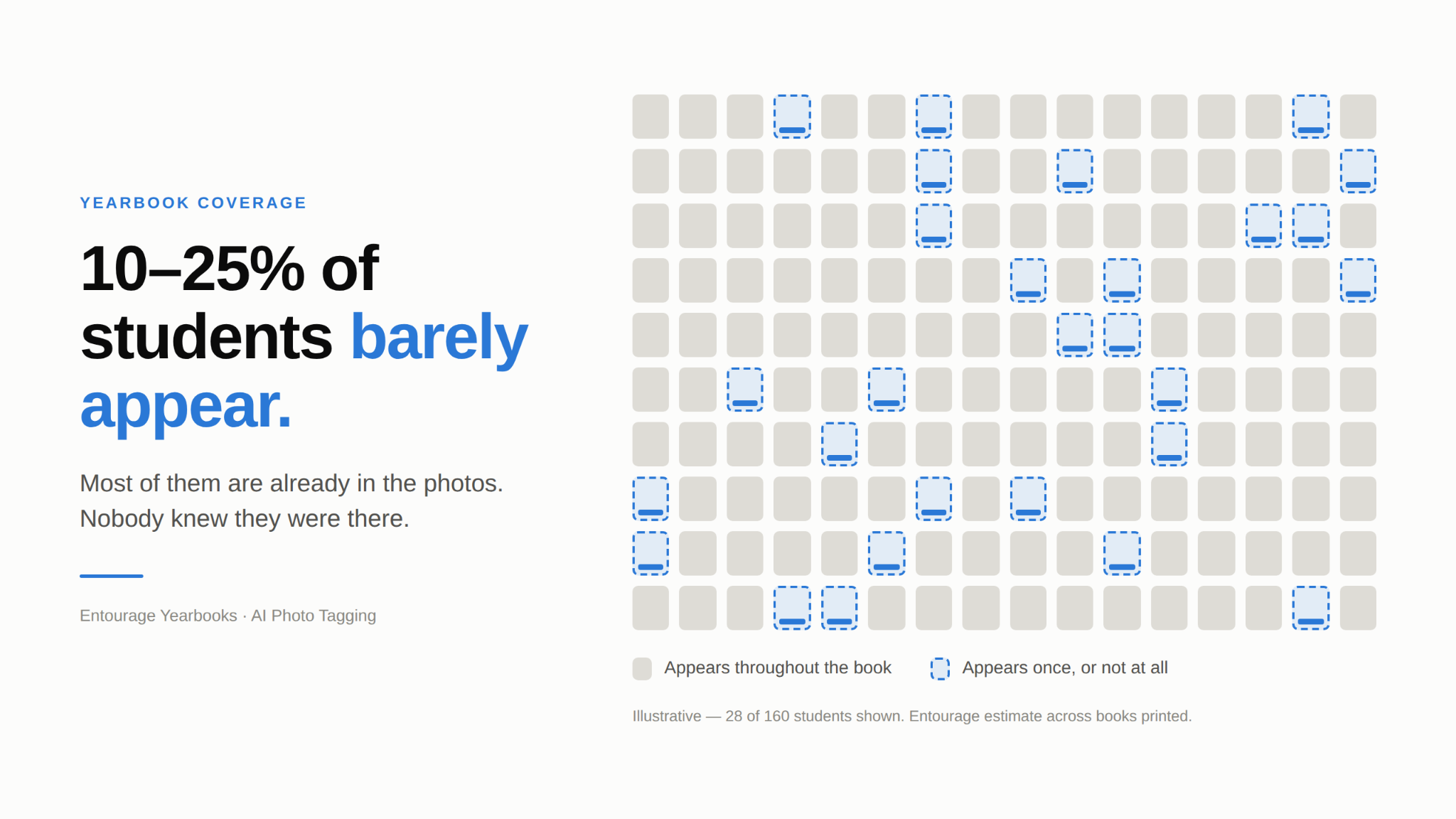
Across the books we print, roughly 10 to 25 percent of students are underrepresented — and in most cases it isn't because the photos don't exist. The photos are sitting in the school's own upload folder. Nobody knew that student was in them.
A yearbook staffer shoots 300 frames at a pep rally. Twelve of them have a sophomore in the background who isn't in band, isn't on a team, and isn't known to anyone on the yearbook staff. Those twelve photos get scrolled past, because identifying every face in every crowd shot by hand is a job no volunteer staff has ever had time to do. The student isn't missing from the school's photography. The student is missing from the school's index.
That's a solvable problem, and since June 2026 Entourage schools have been able to solve it mechanically.
How AI Photo Tagging Works in a Yearbook
Two steps, and the distinction between them matters.
Step 1 — Train. The system reads the school's existing portrait pages. Each student's portrait becomes the reference image for that student — a face the school itself has already attached to a name. An adviser can train the full roster at once, or only the students not yet trained.
Step 2 — Auto Tag. The adviser points the system at a photo category — homecoming, field day, the entire book — and it reviews each candid, detects the faces in it, and matches them back to the trained roster. Matches become name tags on the photo, with a box drawn around the face that matched. It runs across thousands of photos at once, or against a single photo on demand.
One filter does most of the work in practice: count only photos already placed in the book. Coverage isn't about what's in the upload folder. It's about who made it onto a page.
The output is the Photo Index — a per-student count of appearances that previously required a staff member with a legal pad and a month of free periods. An adviser opens it in October and sees, in one screen, which students have twenty appearances and which have one.
And then the important part: for most of those students, the fix isn't sending a photographer anywhere. It's placing a photo the school already took.
The Photo Index is available to every Entourage school. The automatic tagging that populates it is the AI - AUTO TAGGING upgrade.
What It Deliberately Does Not Do
This is where most AI-in-yearbooks coverage goes wrong, so it's worth being blunt.
It does not generate photos. In 2025 a Louisiana high school used AI-generated images in its yearbook and its own graduates publicly called it "a lazy choice." They were right. A yearbook is a documentary record — the entire value of the artifact is that the things in it happened. Entourage does not generate student images and does not intend to.
It does not identify strangers. The system matches only against faces the school supplied through its own portrait data, in a collection scoped to one yearbook. It cannot tell a school who someone is if that person isn't already on the school's roster. It is not a surveillance system with a yearbook interface; it is an index builder that happens to use the same underlying technology.
It does not keep the face data. The trained face collection for a yearbook is deleted once the book is published. It exists for one season, for one book, for one purpose.
It does not make the final call. Every tag is a suggestion an adviser can review, correct, or delete. Photos the system can't read cleanly — no detectable face, several faces where one was expected — are flagged as skipped with a reason attached, not quietly guessed at.
Those limits aren't hedging. Schools operate under FERPA, under COPPA for younger students, and in a growing number of states under biometric privacy statutes that treat a face template as regulated data. Any vendor putting facial recognition in front of K-12 students should be able to answer, in one sentence each, what the system matches against, where that data lives, and when it is destroyed.
"Facial recognition is a powerful tool, and one that requires great care and security. We've taken extensive measures to make sure our AI tagging does one thing — make life easier for yearbook advisers and their staffs — without anyone having to worry about that data being used for anything else." — Elias Jo, Founder and CTO, Entourage Yearbooks
Questions Any Adviser Should Ask a Yearbook Vendor About AI
Not just Entourage. These separate a real implementation from a feature checkbox:
What is the reference set? If the answer isn't "the portraits my school provided," ask what else it matches against.
Is the face data scoped to my book, or pooled across schools and years? Those are very different products.
When is it deleted, and who can confirm it? "At publication" is an answer. "Indefinitely" is also an answer — just a different one.
Can I see and correct every tag? Automated tagging with no human review is a liability, not a feature.
Does the system report coverage, or only tag photos? Tagging is the mechanism. Coverage is the point.
Does the vendor generate any imagery? Know this before your book prints.
Why Coverage Is the Metric That Matters
Face matching is becoming standard equipment across school photography and yearbook software. The interesting question isn't whether a yearbook company has it. It's what the company points it at.
Pointed at production, it saves a staff a week of tagging — real, but a workflow improvement.
Pointed at coverage, it changes what's in the book. An adviser who can see in the fall that sixty students have appeared once can go find the photos where those students already are, and place them. The goal is not a better index. The goal is a yearbook where the number of students who open it and can't find themselves gets as close to zero as a school can drive it.
"The photos were almost always already there. What was missing was any practical way to know who was in them. Once a book is indexed, an adviser can see in a single screen which students have one appearance and which have twenty — and in most cases, closing that gap means placing a photo the school already took." — Nicole Lipnitz, Director of Technology, Entourage Yearbooks
Availability
AI photo tagging is available now to Entourage Yearbooks schools as the AI - AUTO TAGGING upgrade; the Photo Index is included for all Entourage schools. Advisers can enable it through their account manager.
About Entourage Yearbooks Entourage Yearbooks is a modern yearbook publishing company that helps schools design, proof, and print custom yearbooks through an integrated online platform. Part of the ECS family of companies — which includes Picaboo Yearbooks, RememberMe Yearbooks, and Quantum Fulfillment, its in-house manufacturing operation — Entourage pairs domestic printing and fulfillment with a growing suite of design and AI tools built to make yearbook creation faster, easier, and more collaborative for advisers, students, and staff. Learn more at https://www.entourageyearbooks.com.