

Can Yearbooks Use AI-Generated Images? A 4-Part Test for Advisers
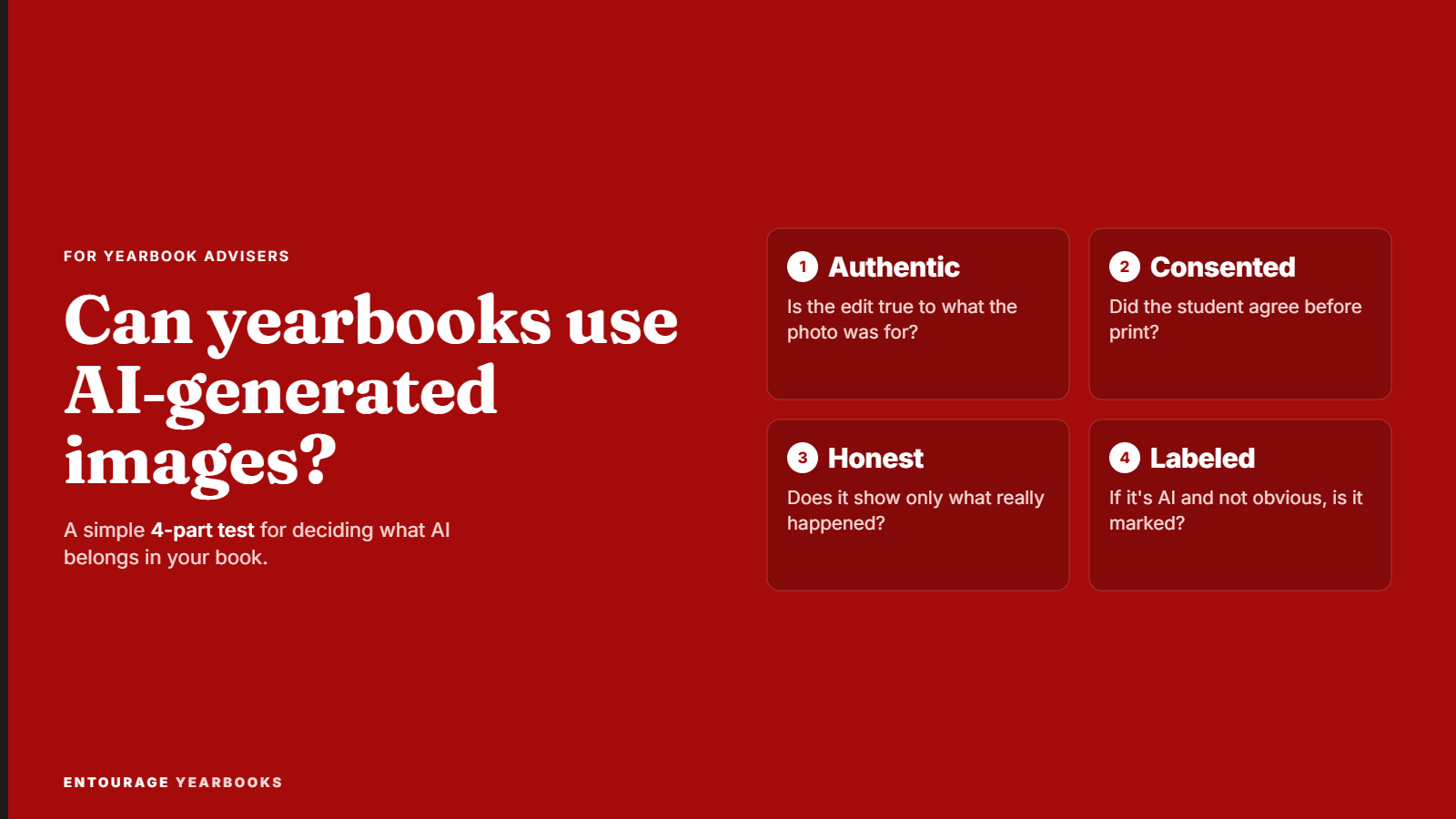
AI is showing up in yearbooks everywhere, sometimes brilliantly and sometimes with a lot of controversy. Here's a four-question test, and a free policy, for deciding what AI belongs in your book.
Can yearbooks use AI-generated images? Yes, with limits. Yearbooks can use AI to organize pages, tag photos, remove backgrounds and create theme art with no real people in it. They should not use AI to generate or alter a real student's likeness without consent, or to misrepresent what actually happened. AI-generated images that aren't obviously AI should be labeled. A written yearbook AI policy is what makes those rules stick.
Why we're talking about AI in yearbooks now
There has been a steady stream of news this year about schools using AI in their yearbooks. Some schools are using it successfully. Others have faced real controversy when students opened the book and didn't recognize themselves.
At Entourage, we're seeing the same thing in the books we work on.
"We've seen an explosion of AI imagery in yearbooks," said Elias Jo, CEO of Entourage Yearbooks. "Some schools are using it a lot, and some are using it a little. The schools that get into trouble usually have a creative, aggressive technology stance and aren't afraid to be pioneers, which is a good thing. But they push it so far that the book loses some of the authenticity of who was actually graduating that year. That's the danger of overusing AI in a yearbook."
The takeaway for advisers is to decide what's in bounds before the proofs go out, not after the books arrive. Here's a simple way to do that.
The 4-part test: an ethics check for AI in your yearbook
Ask these four questions about any image in your book, AI-assisted or not. We call them Authentic, Consented, Honest, Labeled.
1. Authentic: Is it OK to edit yearbook photos with AI?
This test is about edits to a real photo. Every photo in a yearbook exists for a reason: to show who a student is, what an event looked like, what a season felt like. An edit that serves that purpose is fine. An edit that changes it isn't.
"It's kind of like art. You know it when you see it," Jo said. "If you take somebody's likeness and adjust it in a way that's not authentic to what the photograph was for, that's where we draw the line."
Passes: removing a background; correcting color or exposure; fixing eyeglass glare or a blemish on a portrait. Jo notes that school photographers across the country already use AI for this kind of cleanup.
Fails: turning a portrait into a cartoon; changing a face or body; making a student look like someone they're not.
2. Consented: Do you need permission to use AI on a student's yearbook photo?
Yes. AI-generated superlatives or stylized portraits can be fun, but only if the people in them agreed first.
"Using AI to create something like superlative pictures can be fun, but you have to get buy-in from the students it involves," Jo said. "Asking permission in a yearbook is far better than asking for forgiveness after it publishes."
If a student's likeness will be generated or altered in any way, get their approval before the page is submitted. For students who are minors, follow your district's parent-consent rules.
3. Honest: Can yearbooks use AI art for themes and designs?
This test is about scenes and events. AI art isn't off-limits. Theme illustrations, backgrounds and design elements with no real people in them can be a legitimate creative choice. What matters is that nothing presents a scene, person or moment that didn't happen as if it did.
"AI is a new medium, the same way digital art and Photoshop came into the mainstream," Jo said. "There's a place and a method for it. But when it's used to deceive or misrepresent, you know you've crossed a line."
One practical note: using AI doesn't exempt a design from trademark and copyright rules. A theme built around a branded character or show still needs permission to print, whether a person or an AI drew it. And under current U.S. law, unmodified AI output generally can't be copyrighted at all (JEA).
4. Labeled: Should AI images in a yearbook be labeled?
Yes, when a reasonable reader might not realize an image is AI-generated. A small badge, a "photo illustration" credit, or a note in the colophon all work.
"I think it's inevitable that there will be a standard requirement to annotate images generated with AI, and the extent of that AI," Jo said. "In the meantime, using a badge for AI images that aren't obviously AI is good practice to build into your program now."
No national scholastic press group has published a labeling standard yet, but the direction is clear. The JEA/NSPA National Student Media Contests already bar photo entries "created using artificial intelligence tools" or "significantly digitally altered," and accept photo illustrations only in portfolio entries (JEA contest rules).
What if a student misses picture day? Can AI fill in?
This is where a lot of AI trouble starts. A few students miss a shoot, the deadline is close, and generating the missing faces looks like a quick fix. It isn't. A generated likeness of a student who never agreed to it fails the Authentic test, the Consented test and usually the Honest test.
Better options:
Reshoot. Schedule a make-up session, or let students submit a photo taken to your specs.
Use a real candid from your coverage, with the student's OK.
Print "not pictured." It's honest, and it's a long-standing yearbook convention.
Find students early. Coverage tools that show who's missing from your photos in October give you time to fix it before deadline. (More on that below.)
Where AI actually helps: find students, don't fake them
The best use of AI in a yearbook is making sure every student is in it. In Entourage's experience, 10–25% of students end up underrepresented in a typical yearbook, and usually not because the photos don't exist, but because nobody knew those students were in them.
Hundreds of schools now use Entourage's AI features, including AI photo tagging that identifies which students appear in which photos in that school's book, background removal for cleaner layouts, and AI-powered help. Entourage is also building AI tools to make people pages (the student portrait flow) faster and more reliable.
What Entourage does not offer is any tool that alters a student's face or body.
"We don't offer tools that modify a student's likeness," Jo said. "We don't believe the technology, or the risk of someone's likeness being used in a way they don't want, is worth it for most yearbooks. And honestly, if a staff uses outside software like ChatGPT, that's difficult for us to catch. That's exactly why every program needs its own policy."
What happens to student photos when a yearbook company uses AI?
Advisers and parents are right to ask. Here's how Entourage handles it:
Infrastructure. Entourage's AI features run on Amazon Web Services (AWS) cloud infrastructure, and its systems undergo third-party penetration testing.
No outside training. Entourage does not use student photos to train third-party AI models.
Tagging is per book. When a school turns on photo tagging, the recognition data is used only for that school's book and is deleted after the book is published.
Retention and deletion. Under Entourage's Terms of Service, yearbook files are stored for at least four years after the book is finalized for print. A school can request deletion in writing at any time.
Yearbook photo consent in the age of AI
Should advisers add AI language to their photo consent forms? Jo's view: not on their own.
"I don't think individual schools should add AI language to their consent forms on their own. It should be handled at the school board level, because different schools will have different standards and expectations across the country," he said. "But it should be discussed and prioritized the next time a district reviews photography consent."
Questions worth putting on that agenda:
May student photos be processed by AI tools for tagging or editing, and by which vendors?
May a student's likeness be AI-generated or altered for school publications, and with whose permission?
How long may vendors keep student photos, and how can a family request deletion?
Must AI-generated images in school publications be labeled?
What should a yearbook AI policy include? (Free template)
We've turned the four-part test into a one-page Yearbook AI Policy that any program can adapt. It covers what's allowed and what isn't, a rule for missing coverage, a sign-off process, and suggested language your school board can consider during its next photo-consent review. It's free for any school, whether or not you work with Entourage.
Read and download the Yearbook AI Policy Template →
FAQ
What should a yearbook AI policy include?
At minimum: which AI uses are allowed (organizing, tagging, cleanup, theme art), which aren't (altering a real person's likeness without consent, fabricating scenes), a labeling rule, a plan for students who miss photos, and who signs off before pages are submitted.
Can AI replace a missing student's yearbook photo?
It shouldn't. Generating a likeness of a student who never agreed to it misrepresents them. Reshoot, use a real candid, or print "not pictured."
Do student journalism contests allow AI images?
The JEA/NSPA National Student Media Contests bar photo entries created with AI tools or significantly digitally altered.
Is facial recognition in yearbook software safe for students?
Ask your vendor three things: whether it's opt-in, whether the recognition data is limited to your book, and when it's deleted. At Entourage, tagging is used only for that school's book and deleted after publication, and student photos are not used to train third-party models.
Can yearbooks retouch portraits with AI?
Light cleanup that stays true to the portrait, such as removing glare or a blemish, is common practice among school photographers. Changing a student's features is not.
"Using AI to help build and organize your book is a great way to spend more time on the fun stuff," Jo said. "But using AI to take shortcuts, or to misrepresent the authenticity and identity of individuals or a school year, is a dangerous path, and it will only get more perilous as AI advances."
Elias Jo is CEO of Entourage Yearbooks, a next-generation yearbook company that designs and prints books in-house for thousands of schools. Request a free sample →